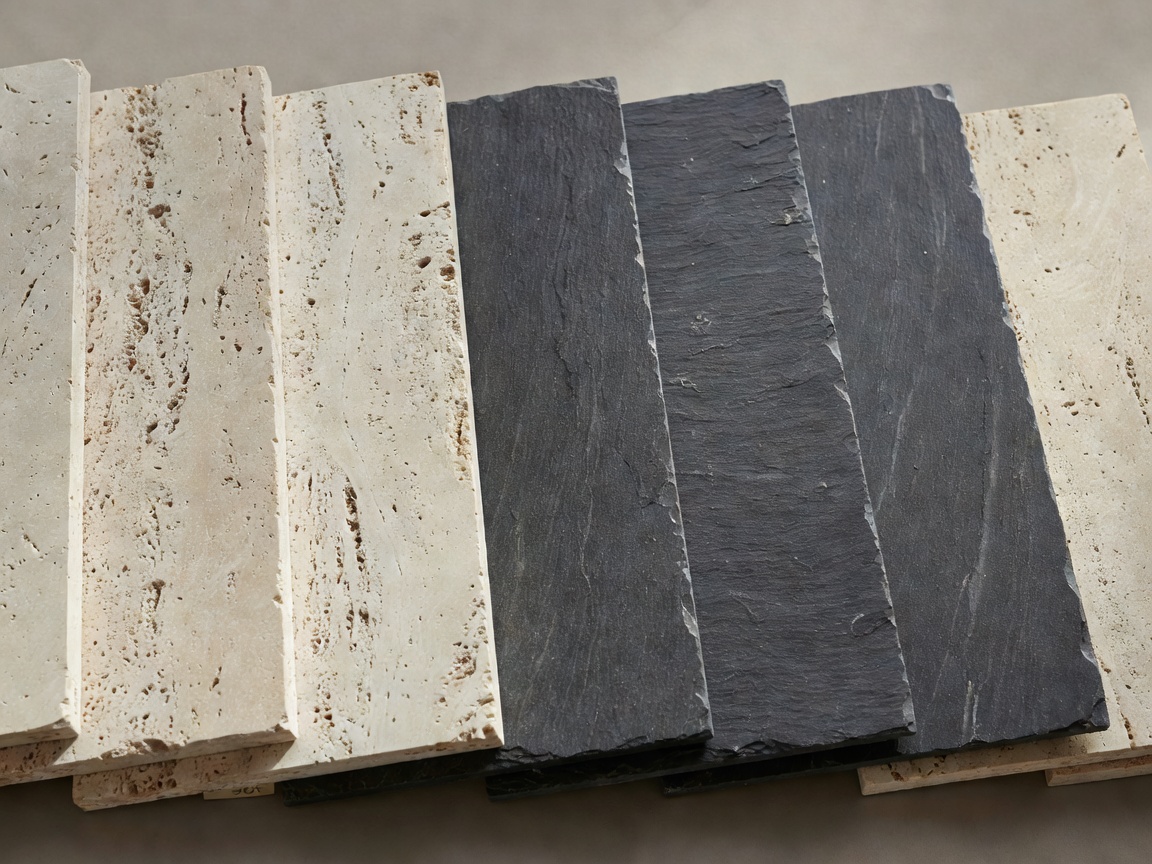
Mineral surfaces range from quarried stone to cast or engineered compositions. Their shared stone-like appearance does not mean shared behaviour. Establish where the surface will be used, how it will be cleaned, and whether the project accepts natural pattern variation.
Natural stone and manufactured surfaces
Limestone often has a quiet, sedimentary appearance. Its composition and surface can vary by source. Some limestone is more vulnerable to acids, scratching or staining than users expect. A honed finish can soften reflections, while a brushed or textured finish changes touch and cleaning effort.
Marble is valued for veining and depth of pattern. It can react to acidic substances and can show etching, scratches or stains depending on the stone, finish and use. A polished surface may make colour and veining appear stronger, but reflections can also expose marks. Honed marble has a softer appearance; it is not automatically stain-proof or maintenance-free.
Granite describes a broad family of hard igneous stones with varied colour and grain. Individual stones differ. Do not use the name alone as a complete performance specification. Confirm the selected material’s finish, porosity and care instructions. Travertine has characteristic pores and banding. Its voids may be filled or left open depending on the finish and application. Edges, filling and cleaning need to be considered as part of the specification.
Slate commonly presents layered texture and tonal variation. Cleaved surfaces can feel uneven; honed or otherwise worked surfaces offer a different profile. Variation across pieces is part of its character, but sample approval should define acceptable range. Terrazzo combines aggregate and binder. Aggregate size, colour distribution, finish and joint layout influence the overall reading. It may be supplied in tiles or formed as a continuous surface; the installation and repair approach differs.
Engineered mineral surfaces combine mineral content with binders and other constituents. Visual consistency may be more controlled than quarried stone, but formulations and use limits vary. Heat, UV exposure, chemicals and installation requirements must be checked in the product’s own documentation. No engineered category should be treated as interchangeable with natural stone.
Porosity, finish and maintenance
Porosity is not a simple label for maintenance. Surface finish, mineral composition, treatment, exposure and cleaning all matter. Sealing may reduce absorption for some stones, but it does not make every stone stain-proof or remove the need for prompt cleaning. Ask whether a treatment is recommended, how it changes appearance, how it is applied and when it may need renewal.
Use cleaning guidance specific to the selected surface. A neutral, material-compatible cleaner is a safer starting point than an acidic or abrasive household product. Acid can mark some calcareous stones. Strong solvents or harsh pads can damage sealers, fillers, polished finishes or binder systems. Keep food, oils, cosmetics and cleaning products from sitting on vulnerable surfaces, particularly in kitchens and bathrooms.
Natural stone varies from piece to piece. Veining, fossil traces, open pores, shade and grain are not necessarily defects. Manufactured patterns are generally more controlled, but production lots can still differ. Review multiple samples or a representative slab when scale and pattern continuity matter. Mark the chosen face and orientation before cutting where possible.
Kitchen, bathroom and interior use
Kitchen work surfaces face food, liquids, hot items, cutting and regular cleaning. Select for the actual use pattern and understand the material’s limits. Use boards and trivets where appropriate. Bathroom surfaces face repeated water, soap, cosmetics and wet cleaning. Detail corners, penetrations, falls and junctions; surface choice cannot compensate for poor waterproofing or drainage.
For floors, check slip considerations for the actual finish and wet conditions. A polished sample may behave differently from a textured one. For walls, weight, fixing, edge treatment and access to services matter. For hearths or surfaces near heat, verify the intended assembly and material limits rather than assuming all stone is suitable.
Good for
- Natural stone where unique mineral pattern is a deliberate part of the brief.
- Terrazzo where aggregate distribution and a crafted mineral appearance are required.
- Engineered mineral surfaces where controlled appearance is useful and the application fits product guidance.
What to know
Request the exact finish and care information, not just a material name. Agree the acceptable variation range. Natural stone can show etching and wear as part of use; manufactured surfaces can still be damaged. Sealing is a maintenance measure, not a substitute for compatible cleaning and sensible detailing.
Selection checklist
- Confirm surface composition, finish, thickness and intended application.
- Review samples for colour, movement, pores, grain and edge treatment.
- Ask about sealing, stain response, cleaning and repair methods.
- Plan joints, slab layout, penetrations and transitions before fabrication.
- Check wet-area, heat and chemical exposure against written guidance.