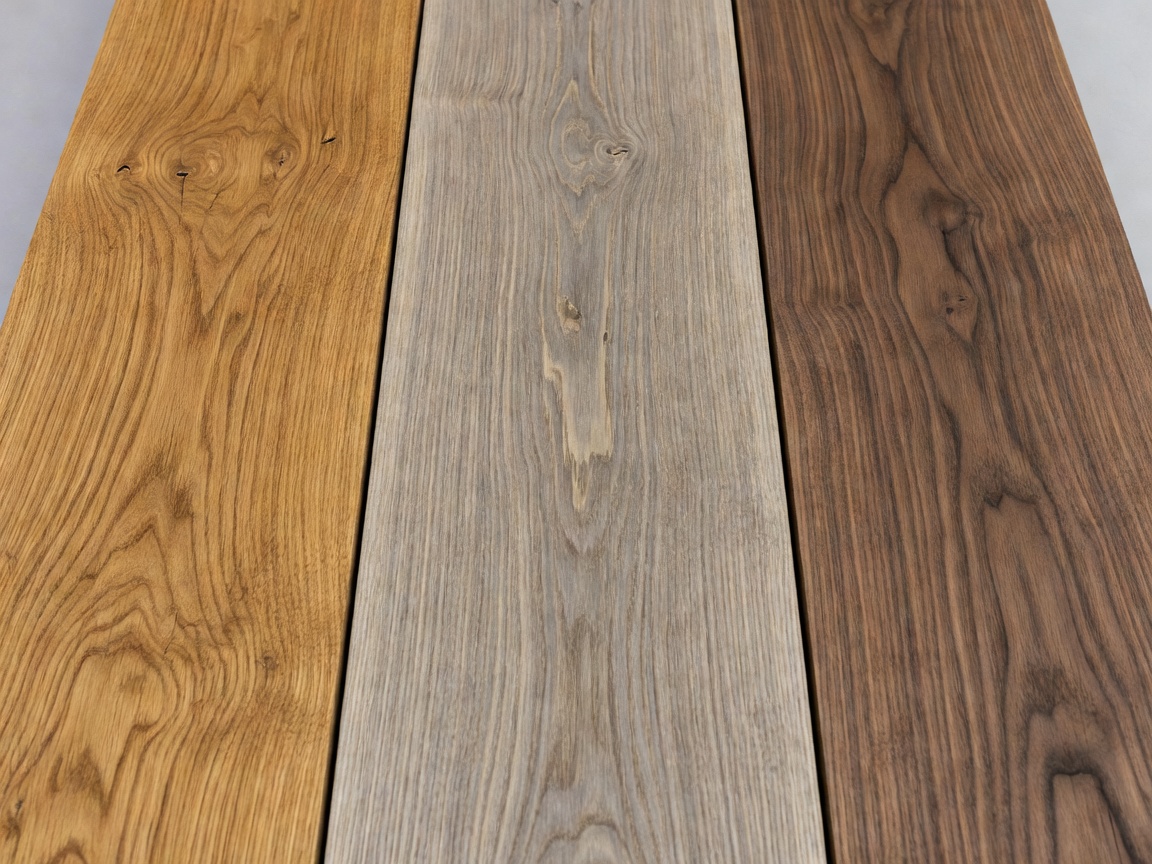
Timber changes with its environment. Moisture, temperature, sunlight and everyday contact affect appearance and movement. Select the construction and finish as a coordinated system, then confirm installation and care requirements for the actual space.
Solid timber, engineered timber and veneer
Solid timber is milled from a single piece. Its grain and colour carry through the section, and some solid boards can be sanded when wear occurs. The available repair depth depends on board thickness, profile and previous finishing. Solid wood moves as moisture conditions change. Board width, fixing method, acclimatisation and site conditions need to be considered.
Engineered timber uses a real-wood surface layer bonded to a supporting construction. Layer arrangements vary. The build-up is designed to manage movement differently from a solid board, but it does not remove moisture sensitivity. The visible wear layer affects future sanding and repair options. Ask for the construction details and written installation guidance rather than assuming all engineered floors offer the same refinishing potential.
Veneer is a thin wood layer applied to a substrate. It can provide a real timber face for doors, cabinetry and panels while using less solid wood at the surface. Veneer is not solid timber, and aggressive sanding can damage through the face. Edge quality, substrate stability, adhesive, humidity and exposure are relevant. The substrate and veneer together determine the assembly.
Oak, ash and walnut
Oak often has a pronounced grain and can range from pale to deeper brown. Its appearance changes with cut, grade, finish and light. Ash tends to show a clear, open grain and lighter appearance, though supply and selected boards vary. Walnut commonly brings deeper brown tones and strong colour movement. Species names do not define a complete visual result: board selection, cut, origin, stain and finish all influence it.
Review a meaningful spread of boards where possible. A small sample cannot show the full range of knots, grain, sapwood or colour that may appear across an installation. Agree the expected visual range and direction of boards. Natural variation is not the same as a fault, but acceptance criteria should be clear before ordering.
Oil, lacquer and stain
Oil finishes can create a low-sheen, tactile appearance and may support local maintenance, subject to the product system. They can require periodic renewal and can be more sensitive to standing liquid or neglected cleaning. Follow the specific care instructions; an oil-finished surface is not automatically easy to repair or water resistant.
Lacquered finishes form a coating over the wood. Sheen ranges from matte to higher gloss. The coating can provide a practical barrier, but scratches or worn areas may need a more extensive repair than routine oil maintenance. Spot repair can be visible. Use only compatible cleaning products and do not treat a coating as protection against standing water or impact.
Stains alter colour while allowing grain to remain visible to different degrees. They can increase variation between boards and make repairs or later colour matching more complex. Test stain and topcoat together on representative timber. A finish should be approved under the room’s lighting, not selected from a digital image alone.
Stability, moisture and installation
Timber is sensitive to moisture exchange. Kitchens, bathrooms, entrances and spaces with strong solar exposure need particular attention. Avoid assuming a timber product is suitable for every wet or heated room. Confirm room conditions, subfloor preparation, movement clearances, installation method and any heating-system requirements with the product guidance and installer.
Acoustics depend on the full assembly: timber construction, underlay, fixing, substrate and room. A floating floor, mechanically fixed board and bonded installation do not behave identically. Check compatibility before choosing resilient layers. Transitions, thresholds, skirting, perimeter gaps and service penetrations should be drawn and resolved in advance.
Maintenance begins with entry mats, furniture protection and prompt removal of spills. Dust and grit can abrade finishes. Use the specified cleaner and avoid wet mopping unless the system permits it. Keep spare boards or veneer where future matching could be difficult. Record the species, finish and batch information for later care or repairs.
Good for
- Solid timber where material depth and potential future refinishing suit the project.
- Engineered boards where layered construction aligns with the site and assembly requirements.
- Veneer for cabinetry and panels where a timber face is wanted over a stable substrate.
What to know
Colour changes under light; wood movement responds to the environment. Neither a species label nor a finish label is a full specification. Document the construction, face layer, finish, installation conditions and care method as one decision.
Selection checklist
- Identify solid, engineered or veneered construction.
- Approve species, grain range, board direction and finish sample.
- Check moisture conditions, substrate and installation instructions.
- Confirm refinishing limits, routine cleaning and local repair options.
- Document edges, joints, thresholds and adjacent material transitions.